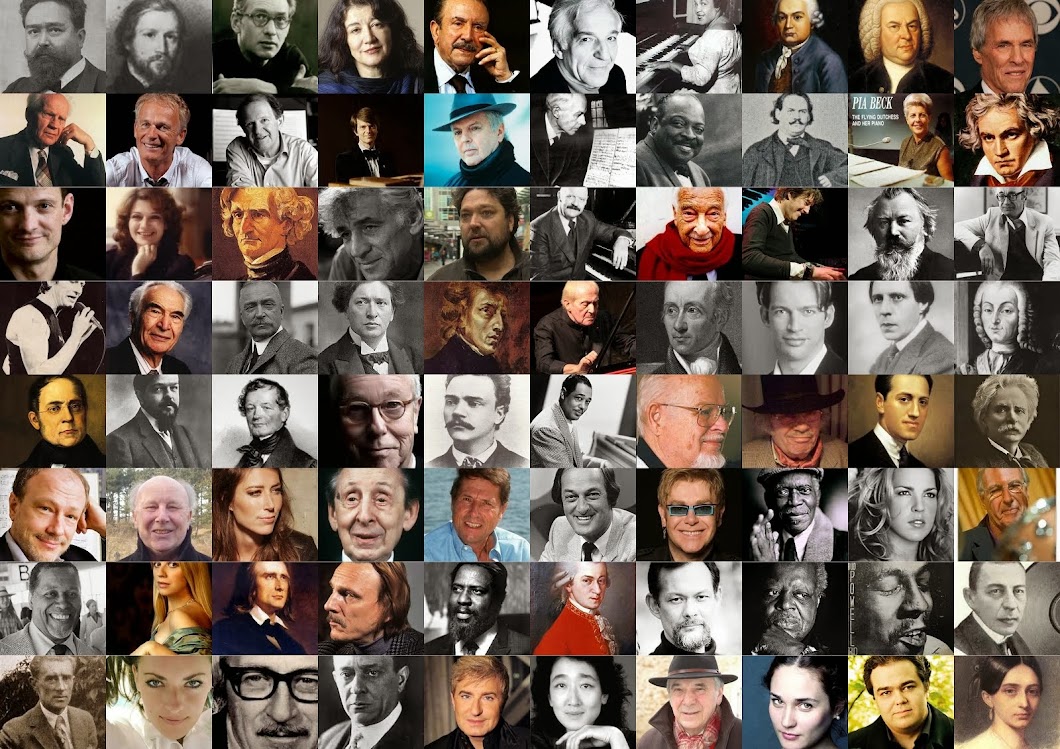
Van Albeniz tot Wieck (sorry for those who aren't in this list.)

Van Albeniz tot Wieck                                 (sorry for those who aren't in this list.)
Isaac Albeniz, Charles-Valentin Alkan, Geza Anda, Martha Algerich, Claudio Arrau, Vladimir Ashkenazy, Winniefred Atwell, Carl Philip Emanuel Bach, J.S. Bach, Burt Bacharach, Wilhelm Backhaus, Cor Bakker, Harry Bannink, Alwin Baer, Daniel Barenboim, Béla Bartok, Count Basie, Carl Bechstein, Pia Beck, Ludwig von Beethoven, Peter Beets, Idil Birit, Berlioz, Leonard Bernstein, Mike Boddé, Jorge Bolet, Viktor Borge, Michiel Borstlap, Johannes Brahms, Alfred Brendel, Herman Brood, Dave Brubeck, Hans von Bulow, Ferruccio Busoni, Frédéric Chopin, Aldo Ciccolini, Muzio Clementi, Harry Connick Jr, Alfred Cortot, Bartolomeo Cristofori, Carl Czerny, Claude Debussy, Anton Diabelli, Louis van Dijk, Anton Dvorak, Duke Ellington, Clare Fischer, Hein van der Gaag, George Gershwin, Edvard Grieg, M.A. Hamelin, Martinus Hersman, Iris Hond, Vladimir Horowitz, Udo Jurgens, Pim Jacobs, Elton John, Hank Jones, Diane Krall, Rob Kreefeld, John Lewis, Valentina Lisitsa, Franz Liszt, Arturo B. Michelangeli, Thelonius Monk, W.A. Mozart, Enrico Pace, Oscar Peterson, Bud Powell, Serge Rachmaninoff, Maurice Ravel, Yana Reznik, Jimmy Rowless, Arnold Schoenberg, Jean-Yves Thibaudet, Mitsuko Uchida, René Urtreger, Anna Vinnitskaya, Arcadi Volodos & Clara Wieck.

Totaal aantal pageviews

zaterdag 19 januari 2013

Another instrument with classic grand piano keyboard (Petrof)

PETROF MIDI grand piano


The Petrof piano company produces not only acoustic upright and grand pianos but per order also electronic MIDI grand pianos. This is an instrument with classic grand piano keyboard, action and hammers, with a pedal mechanism, without an acoustic section, with a sensor strip sensing the movement of the keys and with the sensors sensing the pedals movement. The instrument has a control unit with MIDI input and output jacks for its connecting to a computer.

The Petrof MIDI piano was developed according to demands of piano players, who deal with piano play as well as with musical performances, music composition, with production of movie music, with recording and all sorts of computer processing of music. The most of the electronic keyboard instruments have so different behavior of its mechanical part – keyboard, that it´s unacceptable for efficient acoustic piano players. Using such instruments for a long time the piano players lose their technique that they gained for the years of studies. When they are next changing electronic and acoustic instruments, they have problems with regulating of tone colour and play dynamic while playing the acoustic.

The Petrof MIDI piano is built on a bulky standard key bed whose structure is identical with an acoustic grand piano. It includes standard grand piano keyboard with individually balanced keys and complete grand piano action with hammers and damper parts. At play all the mechanical parts really move, including the side shift of the keyboard while pushing the left pedal, so that the feeling of the player is quite the same as playing the acoustic piano. The piano action and the keyboard are standardly regulated as with acoustic instrument and that is why the behaviour of the MIDI piano is really the same as the behaviour of the acoustic instrument.

As the mechanism of the MIDI piano is identical with the acoustic instrument, it is necessary to practise a regular service of the MIDI piano, that means its inspection, cleaning and regulation. The service of the MIDI piano has to be done at intervals depending on the play frequency, at least once a year. Only this way you can retain really the same behaviour of the MIDI piano as acoustic piano has.

The MIDI piano has a wide utilization, its potential is almost boundless and it depends only on the capability of the attached computer, installed software and attached equipment. The sensor strip is so responsive that it enables to regulate the play dynamics, volume and the tone character such as playing acoustic instrument. It´s available a versatile spectrum of music software, that enables to generate various sounds, tones of assorted musical instruments, to record the music, to record the note score of played music and others.

MIDI GRAND PIANO, SW - POTENTIAL OF USE

MIDI Grand Piano offers to utilize computer applications in many musical activities. Wide range of musical SW enables for example following activities as:
Recodring
AUDIO/MIDI data conversion
Editing
Effecting
Virtual instruments, simulation
Mixing
Mastering
TV and Film postproduction
Score creation and publishing
Scaning of printed score
Playback of score
Transposition
Instruments and voices assignment
Generation of MIDI, AUDIO and Graphic Files
Educational programmes: acoustic anylysis, aural practice, teaching of intonation, rhythm and harmony, teaching of musical appreciation and musical theory, teaching of composition and notation.
The Petrof MIDI pianos can be designed in many different styles. Petrof company designed several types of MIDI piano cabinets, but it´s possible to build the piano for special order in a different form, different execution and different surfacing according to a customer design or according to special demand. The piano can be also built into the sturdy armoured transport case for the concert performances, when the band moves from place to place all the time, when the piano is installed frequently on a stage, for example in the course of the rock groups performances.

maandag 31 december 2012

Fazioli's 4e pedaal en 4e snaar.

Het vierde pedaal is een toepassing van pianofabrikant Fazioli:

FOURTH PEDAL

A new pedal has been created and patented by Fazioli to reduce the sound dynamic and allow playing pianissimo without any alteration of timbre. With the new pedal, the entire keyboard is moved closer to the strings. In this way, the hammers hit the strings with less force and produce a smaller sound without modifying the timbre and the hammer hits the strings in the same place. With the una Corda pedal the soft sound is obtained by moving the entire action to the right allowing the hammer to strike only two strings and thus producing a different timbre.
Consequently with the keyboard shift and the reduction of the distance between the hammers and the strings, the depth of the keys reduces from 10 mm to 7 mm.
In this way the following results are obtained:
Glissando become easier
Fast passages become easier
Better legato
A sound which is much longer and sustained (cantabile)

De vierde snaar is een toepassing van pianofabrikant Julius Blüthner:

The Patented Aliquot System http://www.bluethner.de/nl/indexfr.htm
Generations of piano makers have been constantly attempting to improve the quality of their instruments. Julius Blüthner made an important contribution with the development of the Aliquot System. Patented for the first time in 1872, it was one more step that provided Blüthner's well known warm and romantic sound.Currently, the Patented Aliquot System employs and additional fourth string in the treble section attached directly to the bridge that is not struck by the hammers (Figure 6).
The fourth string is stimulated to vibrate through sympathetic resonance when the other three strings are struck, which results in an acoustical system enriching the overtone spectrum. It produces a very dynamic sound, which is audible over a wide range. This unique effect conveys the resonant treble of the Blüthner piano.
As an example, it is possible to experience this special effect with many of Beethoven's compositions giving an added dimension in tone colour and dynamics.
Another factor that is a great advantage is that all Blüthner strings are individually hitched.This allows for the Aliquot System to develop to its optimum as well as guaranteeing that the strings are tuned exactly. For optimum effect, precise tuning is essential. In today's instruments the 'aliquot strings' are tuned in unison with the trichords.


woensdag 31 oktober 2012

Populair veelzijdig instrument.

De piano is één van de meest populaire en veelzijdige instrumenten. Het toonbereik is groot en wordt slechts overtroffen door dat van het orgel. Ook is het instrument in grote mate expressief. De piano komt in de 19e eeuw tot grote bloei en wordt het huisinstrument bij uitstek. Hij wordt gebruikt als solo- èn als begeleidingsinstrument. Naast het vleugelmodel - klankkast en snaren horizontaal - kent men het rechtopstaande model, dat je hieronder ziet afgebeeld. Dit model is later ontwikkeld en wordt het meest gebruikt omdat het goedkoper is en kleiner.De eerste piano, de pianoforte (dit was een vleugelmodel), werd omstreeks 1700 gebouwd door een Italiaan, Bartolomeo Cristofori, die met experimenten bezig was om een toetsinstrument te produceren, dat meer op de aanraking van de speler reageerde dan het klavecimbel (op dit instrument kon je de geluidsterkte niet beïnvloeden, dus van hard naar zacht was niet mogelijk). Op de pianoforte kon je de geluidsterkte wel beïnvloeden, door de toets zachter of harder aan te slaan. Deze ontdekking maakte het mogelijk dat je op dit toetsinstrument in grote mate expressief kunt spelen.Dit instrument werd pianoforte genoemd omdat je er zowel zacht (piano) als sterk (forte) op kon spelen, iets wat op het klavecimbel dus niet kon.
Informatie over de digitale piano: www.muziekindex.nl/p/frame/digitalepiano.html
Informatie over het electronisch orgel en keyboards: www.muziekindex.nl/p/frame/keyboard_orgel.html
Meer informatie over de piano: De geschiedenis van de piano.


Wil je zien hoe een piano er van binnen uit ziet klik dan op : de binnenkant van een piano.
FAMILIE:
Snaarinstrumenten, ook wordt de piano wel ingedeeld bij de toetsinstrumenten.
NAAM BESPELER:
Pianist(e)
TOONOMVANG:
Ongeveer 7 octaven.
MATERIAAL:
Hout, ijzeren frame en snaren van metaal.
GROOTTE:
De piano is ongeveer 1,2 meter lang.
AFKOMST:
De piano heeft zich ontwikkeld uit de vleugel in de vroege 19e eeuw, toen er behoefte was aan een goedkopere piano die minder ruimte in beslag nam.
CLASSIFICATIE:
Hij behoort tot de groep chordofonen (dit zijn instrumenten waarbij het geluid wordt voortgebracht door het in trilling brengen van snaren).

vrijdag 31 augustus 2012

Yamaha disklavier


Het disklavier.

http://www.clavis.nl/doc/brochure_yamaha_disklavier_mark_iv_pro.pdf
Yamaha's Disklavier assortiment vertegenwoordigt de state of the art piano ontwikkeling.

Hieronder is een opsomming van de technische voorzieningen;
  • It has many new astonishing features, like e.g.:
  • Media Center – Sleek design, which replaces control head (Disklavier will still work!!)
  • Motorized CD-Tray
  • I/O Center – The brains/nerve center of Mark 4 (Harddisk, Linux-PC, etc.)
  • 3 USB-Ports – 1 Host, 2 Device (USB-Stick, etc.)
  • Compact Flash Slot
  • JPEG-Pictures Playback
  • Expansion Ports – Used for future expandability
  • Video Out – Displays Karaoke lyrics
  • Omni Out – Multi-functional ports for any use
  • Digital Audio Output – in addition to existing analogue outs
  • Ethernet – Connectivity with home networks
  • Greatly Expandable Memory - 80 Gb, can hold the equivalent of 80.000 floppies
  • Store CD's– For hours of listening pleasure
  • MSP3 Aktive Speakers – Not on POR-models. Allow fuller sound dispersion
  • Pocker remote control – Large screen, easy to handle
  • Wireless LAN – Gives freedom to move around the house
  • Playlists – Personalize and access your favourite songs
  • Karaoke – Great for familiy sing-a-longs
  • Grey-Scale Sensors – Revolutionary new design
  • New Servo-Magnets – much improved and highly dynamical playback (almost silent in acoustic mode)
  • AEM Tone generator – More realistic voices than ever before
  • Performance Mode – Easy Voice accessibility and layering
  • Key Split – LH/RH seperate
  • Pre installed Software Package - PianoSoft Solo, -Plus, Plus Audio, and much more

More than merely a piano, Yamaha’s Disklavier is a complete entertainment system. Ever since Yamaha introduced hybrid acoustic/digital pianos in 1986, these computer-age ‘player’ pianos have evolved into instruments that can reproduce ‘live’ acoustic piano concerts and ensemble music with instrumental backings and vocal tracks. This unique combination of both acoustic and digital superiority has made Yamaha’s Disklavier the obvious choice of music-lovers, pianists, and educators worldwide.

A True Acoustic Piano with Digital Age Capabilities
In addition to Silent Piano™ system, the Disklavier Mark III Series supports an amazing range of recording, playback, and versatile features, including a digital instrument tone generator for MIDI ensemble performance, SmartKeyTM learn-to-play technology, versatile controls, and comprehensive connections for virtually unlimited opportunities.

PianoSoftTM Brings Live Performances Home
Using Yamaha’s library of thousands of PianoSoftTM software titles, the Disklavier brings ‘live’ performances of legendary artists into your home. By simply inserting the CD and corresponding Yamaha disk, the onboard sound system plays the vocals and fully orchestrated accompaniment, while the Disklavier performs the piano part in perfect time.

PianoSmartTM for Seamless Synchronization
Exciting new PianoSmartTM technology sets a new standard for recording and playback, providing seamless audio synchronization with any standard CD that has a corresponding PianoSoftTM title, as well as the ability to synchronize videotaped performances on the Disklavier and any standard TV monitor.

Mark IV Series – Versatility and Sophistication in a League of its Own
In a step beyond previous models, the Mark IV Series incorporates leading-edges advances, including a high-capacity onboard hard drive and pocket remote control. As a world-class Yamaha grand equipped with today’s most advanced capabilities, the Mark IV is the ultimate piano for home entertainment, business establishments, or creative and educational environments.

zondag 4 december 2011

Mijn piano kraakt.....


Mijn piano kraakt soms in zijn ouderdom
de snaren trillen van genoegen alom
bijna geen dag gaat voorbij
tientallen toetsen staan op eenzelfde rij
de hamers raken de snaren en het geluid ervan remt
van hoog naar laag en hard en zacht tot het wordt getempt
zonder stilte uniek
bestaat er geen muziek.

Op het stemblok van de piano
snaren staan hoog gespannen o zo
en wachten met verborgen toonaarden
de pianist rangschikt deze waarden
keer op keer glijden de vingers over ivoor
wit afgewisseld met een toets zwart ervoor
kruizen en mollen zwijgen op papier
maar krijgen al hun aandacht op het klavier.

Door de loop der jaren
zijn motten en stof gevaren
onderhoud is keer op keer van belang
het beroep op vakmanschap wees maar niet bang
van wel leerden zij zich schikken
met het juiste oor en gereedschap
dat koop je niet in blikken
pak de telefoon en geef zelf de aftrap.

Ja, de piano is opgeknapt en eindelijk weer gestemd
en klinkt bijzonder mooi, niet in cliché uitgedrukt, geremd
mag je zijn, want eerder had veel beter geweest
voor dit overjarige toverbeest
decennia lang al meer dan een eeuw gelee
liep de portemonnee van de 1e koper hiervoor leeg.


Martien Hersman, Haarlem 5 juni 2008

dinsdag 5 april 2011

Mijn pianoverhaal

Mijn pianoverhaal is vooral begonnen als een nieuwsgierige zoektocht, het duurde dan ook werkelijk enkele maanden voor ik voor mezelf een beeld over mijn pianoverhaal kon vormen en dat probeer ik hierbij voor de geinteresseerden te verwoorden.

Enkele vragen, waarop ik probeer antwoord te krijgen:
Waar is het vakmanschap uit het verleden gebleven?
Hoe wordt er nu mee omgegaan?
Wat beweegt en wie beheersen de markt van piano- liefhebbers en - bouwers?

Vakmanschap is een duur goed, enerzijds schaars en anderzijds aan hoog arbeidsloon onderhevig. Desalniettemin is historisch vakmanschap gelukkig overgedragen en nooit verloren gegaan. Marktbewegingen hebben de pianobouwers markten zichtbaar verplaatst buiten Europa. Grofweg kun je zeggen, dat de fabrikanten van weleer door toenadering van marktmechanismen wereldwijd naar elkaar zijn toegegroeid.

Concertpodia worden veelal eenzijdig gedomineerd door bepaald vakmanschap en samensmelting van belangen tussen Broadcast Media, Impressariaten, Dirigenten, Artiesten/Solisten.
Sponsoren en de consument samen maken concerten op hoog niveau mogelijk.

Grote merken zijn in groepen te verdelen en toch is waar te nemen dat het aantal merken is uitgedund en of is afgebrokkeld.

Werkgelegenheid in deze bedrijfstak is door centralisatie wereldwijd elders buiten Europa samen gesmolten. Individuele pianobouwers van toen zijn aangewezen op lokale pianohandelaren en restaurateurs van het heden, vraag en aanbod is opnieuw waar te nemen. Muziekstudenten gaan op zoek naar authenciteit en de volwassen amateurs hebben meer tijd en geld dan vroeger.

De bulk voorraden vinden hun weg naar de consument via internet of piano malls op industrieterreinen.

Grote merknamen van weleer zijn nauwelijks meer verbonden aan familiebedrijven.
Gebundelde krachten zijn ver over grenzen verdwenen met als gevolg dat merknamen herleven in de consumentenmarkt.

Dankzij lokale restaurateurs en vakmanschap blijven de grote "A, B en C" merken behouden sinds het ontstaan van de pianoforte voor nieuwe generaties.

Door de merknamen bewust te hebben weggelaten, ontkom je er niet aan enkele merknamen te gaan noemen om inzicht te geven.

Yamaha, Samick, Kawai en Young Chang zijn economisch zo sterk gegroeid dat zij indirect grote merken bedienen zoals Bösendorfer, Baldwin, Bechstein en Steinway.& Sons en bovendien oude handelsnamen weer nieuw leven inblazen.

Er is een groep van onafhankelijke handwerker pianobouwers gebleven, bijvoorbeeld Steingraeber u Sohnen, Grotrian Steinweg, Sauter en Blüthner.

Er zijn ook nieuwe groepen handwerk pianobouwers ontstaan zoals; SHIGERU KAWAI, Borgato, Fazioli en Stuart & Sons.

Vooral merken zoals Pleyel, Erard, C. Bechstein en Blüthner gaan generaties lang mee of blijven behouden dankzij groot individueel vakmanschap.

Steinway & Sons noem ik even apart, deze “Porsche” onder de piano's tref je vooral aan in concertzalen mede door de steun van broadcasting & marketing. Een grote schaar van artiesten is aan dit merk verbonden of indirect gecontracteerd.

Enkele uitzonderingen kwam ik tegen, zoals Jorge Bolet die altijd zijn eigen Bechstein meenam en tegenwoordig Wibi Sjoerjadi de zalen vol krijgt eerst met Bösendorfer en nu met een aangepaste Fazioli.

zaterdag 26 februari 2011

Score of different piano's

Larking with Piano sound (Jan 2008)
When you vote, we award 6 points for a first choice , 5 points for a second choice etc ................and 1 point for a sixth choice. We then divide the sum of the scores by the number of votes for each piano to arrive at a statistical preference factor.

The rating as of Jan 2008 is as follows:-
( the theoretical possible top score would be 6 and bottom score 1)

Bosendorfer Phoenix.............................................. 4.2
Steingraeber E 272................................................. 4.0
Bosendorfer Imperial............................................... 3.9
Steingraeber Phoenix............................................. 3.7
Steinway D............................................................ 3.3
Steinway Centennial .............................................. 2.3

Before you draw any conclusions please remember this is a comparison of six of the best pianos in the World. ie those rated by the trade as the exclusive and elite classification"Tier One" makes of instrument. All would excel in public recital.

There is one factor that listening does not measure fully and that is the artist/instrument interface. i.e. does the artist feel comfortable and secure? Steingraeber-Phoenix and then Steinway are voted best in this measure when professional artists are asked after playing them live. In simple language they are easier to control. This seems to be related to the nature of the sound from the first impact of the hammer before a defined frequency has established (immediacy) and the length of sustain.


The Bosendorfer Imperial is 35% bigger in sound board area than the other pianos and therefore it has a built in advantage for its bass sound..

We have a few results for Stuart and Sons, but do not include it in the test series because the Makers (rightly) judge that some listeners equipment may not always do the piano justice. Stuart and Sons always ranks in the top three.